Ukrainian by birth, I studied multimedia design in Czechia under Jiří Barta — photography, videography, digital design, 3D animation. This background shaped how I still approach my projects: digital tools are craft accelerators that work only when paired with real talents not replacing them.
I started using early Midjourney and Stable Diffusion models in 2022 to help with my own creative projects. By 2023 I'd learned ComfyUI and taught myself diffusion models' architectures at a level that let me build custom pipelines for small fashion brands and creative agencies.
That work led to a custom Flux LoRA training pipeline — my entry point to FashionLab, where I've spent the last two years building the product.
I brought that technology into FashionLab and joined as co-founder. First as product owner, then as CTO, building the platform with the 500 Global accelerator and two years of production work with fashion brands across Europe leading to the company's acquisition — built from Paris, where I'm based today.

01 — Freelance Creative Projects
Early Midjourney and Stable Diffusion work for my own creative projects, then freelance work for small fashion brands and creative agencies once I'd learned ComfyUI — pioneered custom ai pipelines built one client at a time collecting insights
US based E-Commerce Campaign
One of the first real AI project: a campaign for a US-based Shopify e-commerce brand. the core challenge was accuracy — recreating each product's true color and textile texture rather than a generic AI approximation. End of 2022.


Video Experiments
Early AI video works showreel made using Stable Warp Fusion workflow, before purpose-built video models existed.
Chimi
Eyewear brand project, 2023. Flux LoRA training used to recreate the product faithfully across campaign imagery. the chellanage was to prove that Ai imagery can look visually appealing + introduce color variations of the same product without real samples.


Conzuri
AI ad-creation pipeline built for Conzuri — generative campaign assets produced from Iphone camera made product shots. 3 comfyui workflows: lora training+image generation&editing


02 — FashionLab: Finding Product-Market Fit
Joined FashionLab bringing my own Flux LoRA training in scale technology. For the first year I worked as product owner and AI creative director under another CTO, running tests across different clients to understand where the technology could actually be useful for different brands and to collect data. All of these projects were run in-house on the tech I developed.
Bubbleroom
Developed prior to the availability of image-editing models. The objective was to establish the limits of the technology at the time by combining multiple LoRAs within a single generation and evaluating this approach under real production conditions.
Swedish fashion retailer. The workflow comprised per-garment and per-character Flux LoRA training, a custom ksampler designed to reduce cross-LoRA bleeding, inpainting for garment detailing, and batch upscaling of over 1,000 images to 4K resolution via a custom per-image prompt-generation engine. The ComfyUI face-swap and garment-inpainting workflows were developed independently to address the detail and fidelity limitations of the models available at the time.
ComfyUI inpainting workflow walkthrough, used to replace garments and refine details such as logos, pockets, buttons, zippers, and prints, as well as adjust fit using a reference photo.


Business case: real shoots re-rendered onto models of varying sizes and ethnicities, enabling buyers to see themselves represented in the product.
Fila SS26
Built before any image-editing models existed. Where Bubbleroom combined multiple LoRAs, this project tested the opposite approach: injecting characters and garments as standalone tokens into one larger model, to see which strategy held up better in production.
Dual role as AI tech lead and creative director. Designed 6 distinct AI characters trained into a single Flux checkpoint, generating 20+ looks across 60+ garments from the new collection — built and directed alongside Fila's marketing team lead, Peter Bader. Reused and adapted the Bubbleroom inpainting comfyui workflow for Fila's garment detailing.


8848
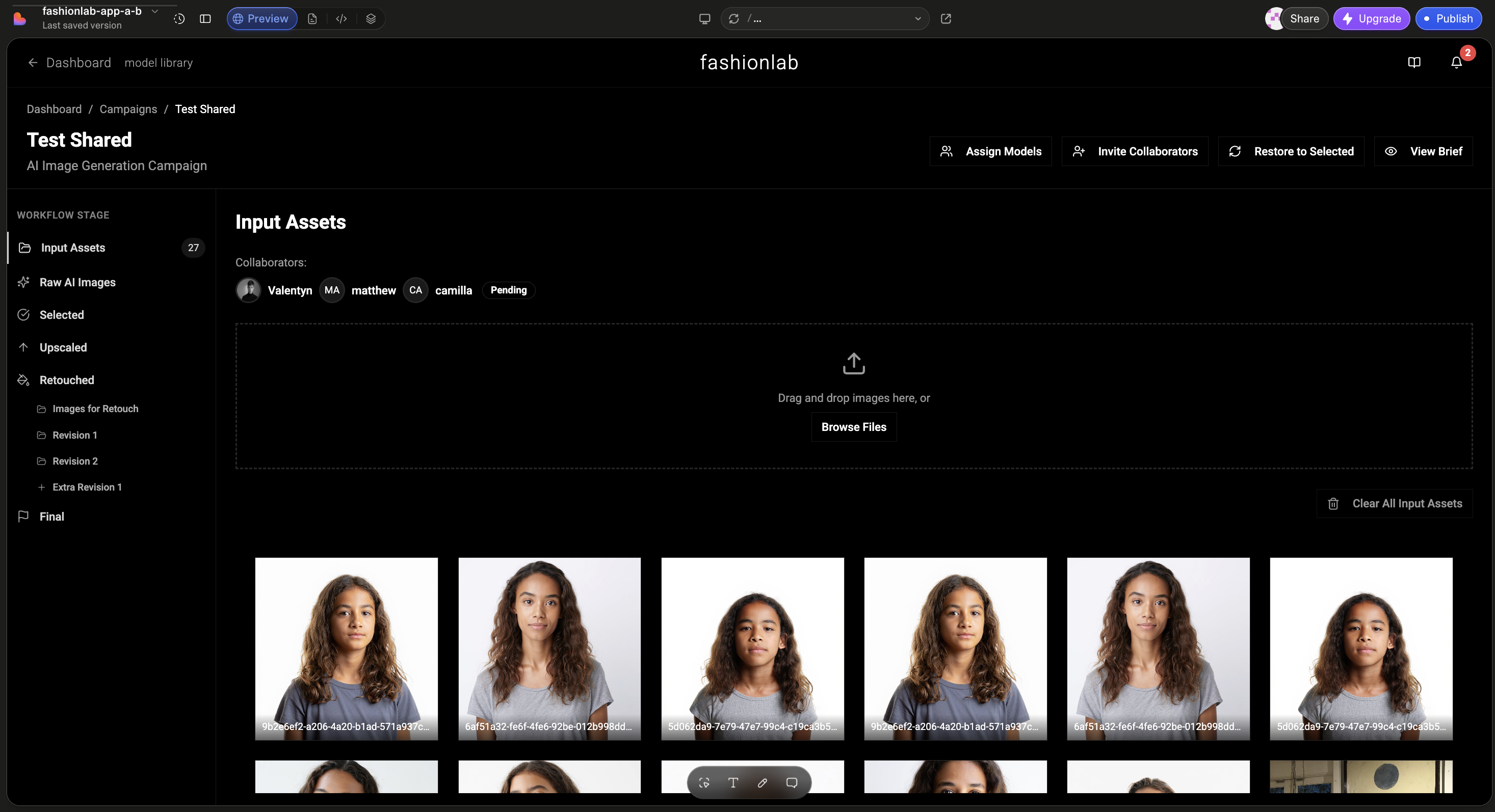
Ski brand. Same "sizing" use case as Bubbleroom, but the goal here was different: understanding the optimal UI we'd need for users to generate these images themselves, at scale. This is where our self-service platform's UI and UX started — I vibe-coded an MVP in Lovable that later became the FashionLab platform.
LabFresh
Innovative European fashion-tech brand — one of the first to test AI imagery and actually post it publicly in EU, back in early 2025. I designed custom characters in two sizes myself and generated the images by hand (still not self-service at this point). Challenge: accurate fit & their innovative textile folding and light reflection. Result: the product sold out in a day, which hadn't happened to them before; reduced asset production time X5.

03 — FashionLab: Building the Platform
After a full year of testing and collecting feedback across client projects, I became CTO — built the product roadmap, built the MVP, and with that we joined the 500 Global accelerator. Over this period I personally sourced and hired 4 developers from Sweden, the US, and Georgia, and together we built the first version of the self-service platform in 2.5 months and launched in January 2026.
500 Global Accelerator
FashionLab was accepted into the 500 Global accelerator, validating the platform against a global cohort of investors and operators and sharpening the go-to-market that carried the product through to acquisition.
Self-Service Platform Build
Built in ~3 months once the first image-editing models arrived — Flux Kontext, then Nano Banana, Seadream, Qwen — all still immature. The focus shifted to finding a UI that let brand teams generate, edit, review, comment, retouch, and approve fashion product images at scale — thousands per week. As a result we enrolled brands like Oriflame, Weekday and Marimekko along with many mid size EU brands.
- Generating an image requires several passes and editing tools — we needed easy navigation and the infrastructure to support it.
- To generate thousands of images, we needed a structured image manager with distinct stages.
- Generation logic should mirror how brands already work: create looks and write a creative brief, land in a "raw" folder of generated images and videos, move winners to a "selected" folder, then retouch (built-in Photoshop-style tools) and give the team access to review, annotate, and comment.
- Brands need full control over their visuals, so we traded some UI simplicity and activation time for more advanced tooling.
- Marketplace: smaller brands don't yet have people who can generate images, and aren't ready to commit to hiring or learning AI tools — they need support. My idea was a marketplace, like Upwork or Fiverr, where the best AI creators could be hired by our brands. Brands get results faster and start trusting the tool, while we open up a new "creators" market that also buys our subscriptions.
ComfyUI Workflows on Top of the Editing-Model APIs
Two proprietary ComfyUI workflows were developed to operate on top of the third-party editing-model APIs, addressing their remaining limitations.
Face Swap
A custom face-swap workflow developed to preserve identity consistency across generations.
Background Color Accuracy Corrector
This workflow evaluates whether a generated background meets a defined color accuracy standard and, when it does not, corrects hue and contrast accordingly. As this workflow constitutes FashionLab intellectual property transferred with the company's acquisition, further details cannot be disclosed.

valentynshumdesign@gmail.com